Shelton's Big Regrets, Alcaraz's Big Revenge: How Carlitos Punished the Missed Chances
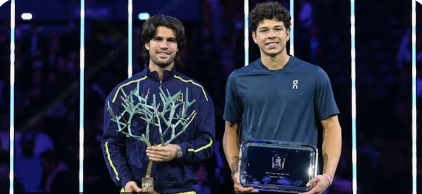
Carlos Alcaraz's great run of form continued as he beat rival Ben Shelton 7-6, 7-5 to win his first ever Paris Masters title. The Spaniard is now just two Masters titles away from completing the full set of winning every Masters trophy at least once.
Historically, Alcaraz has struggled doing well and going deep at the Paris Masters. Who can forget the early exit to Hugo Gaston in Carlos' debut appearance here in 2021? It has not been a comfortable journey since, but I always felt Alcaraz would find a way. As he normally does.
This title triumph was even bigger due to the opponent he was facing on the other side of the net. Shelton had got his first victory against the Spaniard in New York just a couple of months ago and Alcaraz had actively talked about getting some revenge. Didn't he just.
Some of the tactical plays that Alcaraz utilised in this Paris final was similar to the ones he used in that loss and I will be looking to draw some comparisons during the breakdown. Here is how the Paris Masters was decided.
First set missed opportunities cost Shelton the match
The conversation before the match was about the volume of returns that Shelton could get into play and who would dictate the terms of engagement of getting their game-style imposed on the final. Shelton started the better and drew up three break points in a row at 2-1* 0-40. What was about to take place was essentially the story of the match. Many missed opportunities for Shelton in a phase of the contest where Carlos was looking human for once.
The first break point of six in the first set for Shelton (via ATP Tennis TV)
In the first of those break points, Shelton does the right thing and ensures he is in the point to begin with. Carlos holds firm and Shelton eventually hits one of many nervous-looking forehands miles long. It is easy to say that there is no pressure on this shot. There is pressure on this shot due to the calibre of player he is facing. The larger issue is that it is one of many rallies from the ground that he did not deliver in. Shelton finished the match with just 39% of baseline points won which led to his desperation to avoid it even more in the second set. Shelton's deficiencies were there even in a set he perhaps should have won.
In the second break point, Carlos gets a freebie out of the backhand early in the point. But here in the final break point of three in a row, Shelton once again comes up short in a longer exchange where he eventually sails a forehand long. These style of points always favoured Alcaraz where they got a bit 'funky' and less about simply trying to muscle from the back. Another groundstroke-heavy exchange that Alcaraz comes out on top in.
Shelton's deficiencies still there on the 3rd break point. His third of six that passed him by in a set that escaped him (via ATP Tennis TV)
Shelton created a fourth break point in this game that was abruptly saved by a third ball forehand winner from Carlos. That pattern of play took over the matchup later into the opening set onwards. It might have felt very early in this encounter to declare this, but here on in it went from Shelton's type of match to Alcaraz dragging Shelton into murky waters of his preferred territory.
Shelton's last two break point opportunities of the first set came at 4-3* 15-40. I would like to prioritise drawing your attention to the first of the two break points that Carlos saves. It is basically backhand examination to the absolute maximum. The Spaniard initially tries to beat him with predictable elevation to that side and then wins the point through assessing the risk and great pattern recognition. There is intention behind the initial high ball, the direction of the net approach, and sticking in the same zone for the last volley. Once again, Shelton did not break down in this face-off, but he also did not give Alcaraz anything to fear either. A short-term win that led to a consistent long-term one for him.
Alcaraz saves break point No.5 with a strategy that flipped the set and match to his favour. (ATP Tennis TV)
Alcaraz dictated terms of engagement tactically in second half of first set
Alcaraz survives those break point scares which were huge as it could have altered the outcome of the match. That may have given Shelton the confidence he was looking for. From then on, Carlos is calling the shots from a strategy standpoint even in the scoreline remained tight. Mainly through a combination of preying on a weakness while restricting Shelton's success rate in the only areas he could trouble Carlos.
The Alcaraz tactical playbook for when he faces Shelton. (ATP Tennis TV)
Alcaraz did something that was the same tactical playbook that he utilised in his defeat to Shelton at the US Open. It involved floaters to the backhand and then it opens tactical paths that Alcaraz can capitalise on on the next shot. This led to easy third ball forehands middle of the court, drop shot possibilities being there or an easy volley out of the air.
Shelton did not lose this based on the backhand leaking errors. He lost this based on what he could not do with that groundstroke. Alcaraz was content with Ben getting returns inside the court as Alcaraz was less focused on free points on serve and more concerned about having easy routes to finishing Shelton off from ground thereafter. This did not happen much at all in the first six to seven games but after that it was the most vital aspect of the match.
The key difference in the finalists n this Paris Masters match was that Alcaraz took care of the non-negotiable scenarios way better than Shelton, as you will see in the tiebreak escalation from the American.
Alcaraz's tactical playbook was even there a lot in the match he lost to Shelton in New York (US Open Youtube Channel)
Alcaraz begins to gradually neutralise the serve late in the first set onwards
Shelton could not express himself with his best serve which led to panic stations on next shot. Alcaraz had him where he wanted him in these points.
Alcaraz gradually being able to neutralise and nullify the Shelton serve was problematic for Ben and it is another example of Alcaraz limiting Shelton's viable options of winning this match.
In the above video, Shelton hits his preferred lefty serve out-wide and still gets a very inviting plus one forehand to work with. Shelton sprays the forehand wide under pressure. It was an inexcusable point to lose in this tiebreak, but it was a snapshot of the pressure Alcaraz started to put him under by making Shelton feel that specific serve was no longer impactful enough for him. Now at this point he is in Alcaraz's territory and Alcaraz's world.
Alcaraz seals the first set in the tiebreak
Alcaraz wins the set and demonstrates all the issues Shelton was feeling in the final in one point (ATP Tennis TV)
This set point encapsulates everything that Alcaraz was doing well to get the upper-hand. Shelton hesitates off the next shot after the serve as at this point he is ensure whether the lefty-serve will do the business and give him anything. He gets the confirmation that it will not as Alcaraz sends in a high quality deep return. Alcaraz has him where he wants him on the biggest point of the first set. A baseline rally where Alcaraz is more comfortable, while Shelton is already aware his core strengths are either failing him or being suppressed.
Shelton has no assurances at net
Many people believed that in order for Shelton to be able to get his second ever win over Alcaraz that he would have had to succeed in winning points at the net a lot.
Shelton actually resets his tennis well at the beginning of the second set. He gets an unexpected break in a game where Carlos double faults and then stretches a forehand wide of the mark. At this stage of the set Shelton has a degree of control in terms of scoreline. He is leading *4-2 and has just held to love and has won 11 of 13 points. Shelton's best phase of the match.
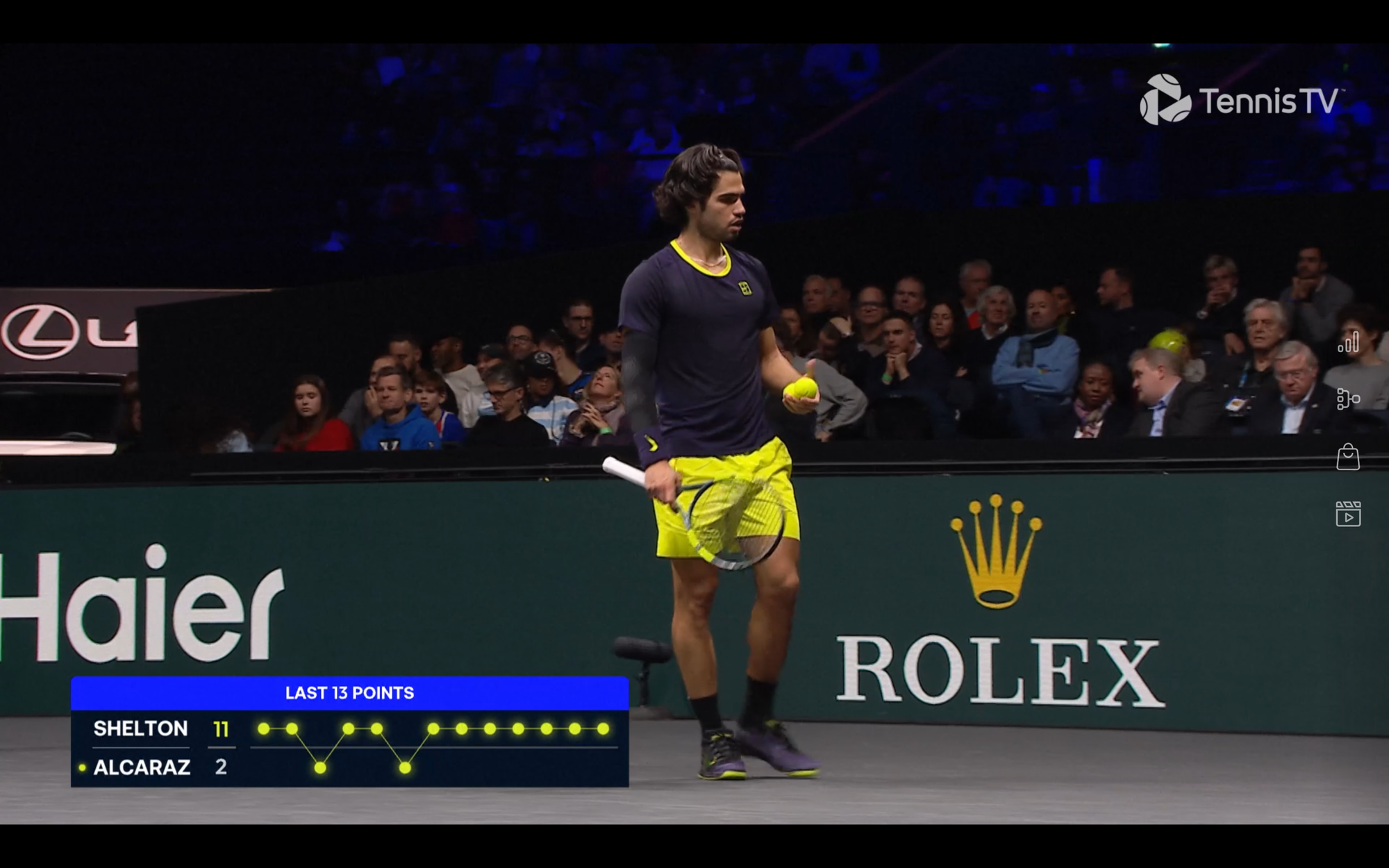
What could go wrong? As stated previously, Carlos already had a measure of control on how to beat Shelton and it was working effectively. We discussed high balls to the backhand to open up point-winning scenarios. We talked about defusing the lefty serve to great effect and exploiting Shelton's panicky tendencies from the ground. The last part which allowed Carlos to turn a break deficit to a comeback set is by not allowing Shelton to dominate at the net. Shelton finished with just 52% of his net points won. The second set changed because of this.
Carlos managed to turn profitable net situations for Shelton in the 1st set to points in which he was winning regularly. (ATP Tennis TV)
In the above clip, you can read Shelton's thought process. He knows he is at a huge disadvantage rallying with Alcaraz as it is a non-contest based on what he had experienced in the latter part of the first set. Shelton wants the point done and dusted with the very first forehand but Carlos defends well. Shelton wants to avoid a backcourt point at all costs so he is rushing to the net regardless of what the approach looks like in terms of standard. Unfortunately, Alcaraz knows Shelton is desperate to do just this. He reads his intentions, sets the trap and executes with a great passing shot.
Another net point where Shelton came up empty-handed. This time on match point down (ATP Tennis TV)
The match point is another example of Shelton having no hiding place in this final. He is forced to play two volleys and still has no shortcut out of the point. Alcaraz dispatches the last backhand away to seal the win.
The takeaways from this final is obviously that Shelton will have huge regrets on not taking those six break point opportunities in the first set. But I also feel it illustrated the importance of having more than one way to skin a cat. Not only did Alcaraz have the better of Shelton in Alcaraz's territory, but he was living in the American's head in strategic situations that suited Shelton by the tiebreak onwards.
Shelton could not count on his ideal serve. He could not keep the points extremely short on the first strike and he could not come in frequently with great success at the net. So what did he have to feed off? Virtually nothing. But it is important to remember why he had nothing tactically. Because he was not allowed to.
Just sixty-days after a late night finish in Flushing Meadows, Alcaraz already has some revenge in a final that showed that Shelton may have something but Alcaraz has everything on a tennis court.

Comments ()