
Serve Broken, History Made: How Alcaraz Toppled Zverev for Turin Title
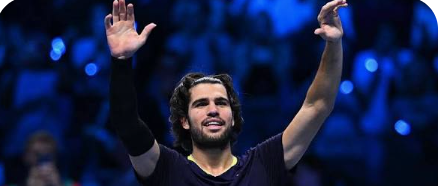
Carlos Alcaraz prolonged the 'best player in the world' debate, as he defeated Alexander Zverev 6-2 7-6 in the Turin final. This marks the Spaniard's first ATP Finals title, making him only the fourth man to win all four majors and the season-ending championship.
The journey to get to this final was compelling to say the least. Alcaraz would be tested at his most from a physical aspect, but Zverev would also be challenged psychologically more than any present matchup on tour. Zverev's rise to the top of the rankings by winning two major titles had come during a period where Alcaraz was largely absent. Therefore, a lot of questions were going to be answered in this final.
So how did Alcaraz continue his superiority over the German? Where did Zverev fall short? I will go through each detail as we break down the Turin final tactically.
Alcaraz did not give Zverev an easy ride out of service points
A major factor in Zverev's success—not just indoors, but anywhere—comes down to what he can achieve from his first serve alone. It often revolves around frightening percentages and the success rate that comes with it. Both of those things worked out well for him in his previous matches this week, but he was playing a different calibre of returner in the Turin final.
Going into this Turin final, I felt Zverev needed easy points on serve—and a quick put-away on the next shot—to have a chance of winning this. If these things did not happen often enough, I felt that Carlitos could explore all of the strategical tools he has at his disposal from the baseline. Those tools would exacerbate Zverev's tendency of being very tense and passive from the back too. Both of those things took place on a regular basis in this final.
In the above video, Alcaraz gets a strong return through the centre, then starts working on where he can hurt Zverev to the maximum. He draws the shorter offering out of the Zverev forehand and it enables him to take control of the centre. Carlos knows he is winning these points 9 times out of 10 if he executes right. There would be shockwaves going through the German's system with how the match was already shaping up.
Alcaraz took apart Zverev's forehand through trajectory change-up
Everyone knows that Zverev's forehand is the weaker wing. But it can be exposed extensively on how you address it from a tactical standpoint. A high percentage of shots in that corner may get the job done, but it will not always. Alcaraz felt it was better to take that groundstroke on through disruption and trajectory change-ups throughout this final.
Alcaraz felt that taking on that groundstroke through giving Zverev a mix of everything was the way to go. He was correct. As you can see in the video below, Alcaraz opens up the court with a subtle angle into Zverev's forehand wing, and then follows it up with a deliberate soft ball that draws the German into the court. He gets the error as a result of this.
This proved troublesome for Zverev because it led to him overthinking every forehand stroke based on what Alcaraz was giving him. Zverev prefers steady pace to feed on and he got the opposite.
Example of Carlos changing up the versions of shots going into Zverev's forehand (ATP Tennis TV)
Another way Alcaraz was able to unsettle Zverev’s forehand was by throwing up high balls. It may not usually be that effective in isolation against a player with such a tall frame like Zverev. However, when combined with the regular slices and off-pace balls he was having to deal with, it made this play even more fruitful.
Alcaraz threw up high balls to make those change-ups even more problematic for Zverev (ATP Tennis TV)
Alcaraz's chipped return was unbelievably effective in this match
Zverev won just 54% of his first serve points in this final. This represents a 19% drop-off in points won in that department compared to when they last met at this tournament two years ago. A big reason for that? Alcaraz's ability to get returns in play through smart chipped returns. Greater versatility on the return, paired with a confident baseline strategy, worked absolute wonders for Alcaraz.
Alcaraz used the chipped return very well. It got him into so many return points against Zverev (ATP Tennis TV)
Many people would look at this return point and question the quality of Alcaraz's chipped return. However, when you look at the intention and context of the match leading up to this, it is superb. Zverev can have some days where he eases into routine plus-one shots to swat away. But when you look at what had happened in the match before this, Zverev was already doubting this scenario based on being deprived of it so much in the first set
Alcaraz asked Zverev the question of whether he could out-ball strike him
Throughout his Paris Masters triumph, Alcaraz's primary focus was taking control of the center of the court as early as possible. That still happened against Zverev, but he made a greater effort to test whether Zverev actually had the capability to out-ballstrike him. Zverev lost this by a landslide and rarely came up with genuine solutions. But why was it so one-sided? As stated previously, Zverev becomes way more exposed when he cannot hit the jackpot with his first serve delivery and what it gives him.
The baseline vulnerability is huge against Carlos, firstly because his game has far more identifiable layers—including weight of shot and variation from everywhere on the court. But he also had the beating of Zverev psychologically. I felt Zverev had a lot to prove in relation to the discussion over who the best player in the world actually was. The second set tiebreak emphasised the psychological edge that Alcaraz still has.
Alcaraz was content asking Zverev to try and be the better ball-striker. Zverev had little response to this outside of spells of the 2nd set (ATP Tennis TV)
Fortune favours the brave as Carlos clinches the title in the tiebreak
In many of their recen encounters, the conclusion is that Alcaraz trusts himself in the big moments, and Zverev simply does not. This usually sees the Spaniard play bolder and more ambitiously under the spotlight than his counterpart. It did not change in this Turin final second set tiebreak.
Alcaraz sets the tone in 1st point of the tiebreak (ATP Tennis TV)66
Carlitos once again tries to get some change out of the Zverev forehand through devious changes in trajectory before stepping in and taking control of his destiny before Zverev does. He was not overly conscious of Zverev taking control of the point before him. He just knew he would be allowed to do so anyway.
Alcaraz would then go off track by losing six points in a row after taking up a 3-0 lead in the tiebreak. Nerves were definitely in play for Alcaraz, but the lasting impression was that he was making the first adventurous play most of the time. That included poor execution of the drop shot or a wayward forehand. He was still willing to call the shots despite the tension rising.
The first two Zverev set points were saved by a lovely Alcaraz drop shot, followed by him dictating with his forehand. Still being brave. Now the next point is where the tiebreak was won and lost.
Zverev reverted to type of doing less when the big matchup was requiring more (ATP Tennis TV)
The final Zverev set point is the most eye-catching example of what the German failed to do. It is a set point on his serve and he has a huge chance to change the direction of the match with both hands. Carlos feeds him the most glaring opportunity to accelerate through a proactive forehand and he chooses to do less. Carlos reverts to asking Zverev whether he can outplay him from the back. Once again, no answers here. Alcaraz is the Turin Champion.
Fortune favours the brave. Alcaraz won the match because Zverev was more focused on not losing it. (ATP Tennis TV)
The Biggest Takeaways
Firstly, this match shows the evolution of Carlos as a player in the space of a couple of years. It was clear in Alcaraz's defeat to Zverev at this event two years ago that he was too eager to go for winners too early. He often played into Zverev's hands by doing this. Alcaraz was less flashy and more in control of his baseline game this time. It showcased his improved maturity and greater understanding of what hurts most of his opponents more. That adjustment still does not strip away what makes him so good as an elite player either. The shotmaking ability still remains.
It creates more discussion about who the best player in the world currently is. Zverev is officially the No.1 player according to the rankings. However, Alcaraz is performing like the best player in the world. This result is more evidence of this. Zverev racked up two major titles and became the World No.1 during a period where the two strongest players were largely absent. The onus was on Zverev to deliver on an indoor surface that was his patch and his place of habitat. Alcaraz prevailing the way that he did suggests the scar tissue is still there. I didn’t say it—the tiebreak did.

Comments ()