Need for Speed: Coleman Wong advances to Guangzhou Challenger Final as Top Seed
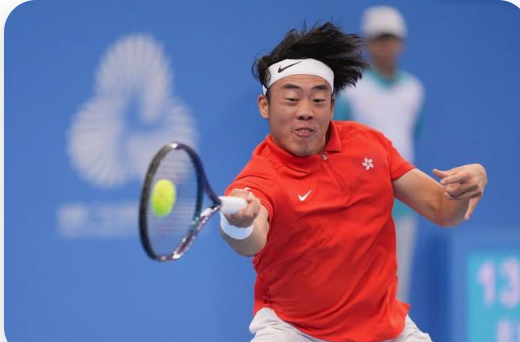
Two clear things have been evident in the Guangzhou Challenger tournament. The first is that the courts have to be considered as some of the quickest conditions of all the tournaments we see throughout the season and the second is that Coleman Wong clearly absolutely loves this.
I was lucky enough to be a spectator in person for the Glasgow Challenger back in 2025 and I managed to see Coleman Wong win his first round match against Germany's Molleker and then go on to lose in a three set battle with Norway's Durasovic. Not a bad loss in the way Durasovic was striking the ball during that period and he ended up making the final.
But I was already gathering some intel on what Wong potentially requires as a player in terms of conditions, speed of surface, and what he needs to improve himself on top of this. I always felt the quicker the court, the better the player when it comes to Wong. The reason for this is because I believed he always had a good serve. The numbers provided by Tennis Abstract below confirm this and they also confirm that Wong's quality of serving has pretty much improved year upon year.
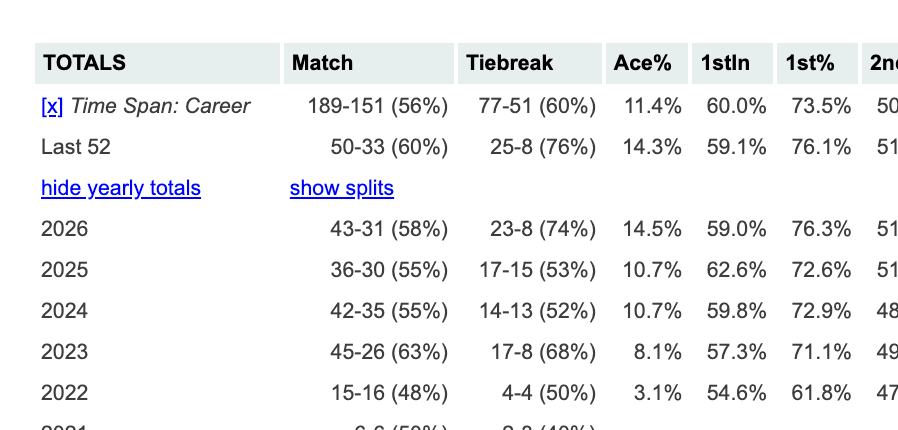
But I also feel like the added variable of quicker speed of surface would enhance it further and Guangzhou solidifies that for me. He also always had the weapons to a degree in a point but sometimes could do with further assistance in that regard admittedly.
The Guangzhou Challenger being one of the quickest tournaments on tour has led to Wong producing some of his greatest ace counts ever. Wong has hit 76 aces in just four matches so far and will likely go on to deliver many more in the showpiece final versus Australia's Tristan Schoolkate too.
When analysing the first set tiebreak of his straight sets win over Zhou in today's semi-final, the first thing that is noticeable is that vulnerability around second serves is less of a thing in Guangzhou. Here Wong is able to get quite an easy free point off a second serve rearing up. The game changer for Wong is that these conditions have armed him with more of an attacking second serve but also restricted the amount of back-foot tennis he is playing behind it additionally. He goes 2-0 up in the tiebreak here:
Wong capable of many 2nd serve free points in Guangzhou (via ATP Challenger TV)
Wong pulls ahead with another first serve ace on the next point and then adds another ace in the video below on one of his best serves of the match to go 4-2 up in the tiebreak. The point I made earlier about the serve being boosted enormously being something that Coleman not only desires but requires is apparent in the midst of this tiebreak. He distances himself from Zhou through the serve and serve alone in a match with a lot of jeopardy as Zhou was right there with him throughout the set.
Another reason I think the serve being boosted in quicker conditions supports Wong is because I have never envisioned him as a deep thinker on a tennis court. This simplifies things massively for him while also getting what he needs to get out of rally too. It allows him to be the instinctual and straightforward kind of player that he is even more.
Wong's exemplary 1st serve serving (via ATP Challenger TV)
The next point in the tiebreak is where Wong goes up 5-2* and it comes from the value of the second serve in Guangzhou again. This time it is not about the quick points he can garner off what would ordinarily be a weak area. But what he can bring into the equation tactically-speaking behind a 2nd serve. Here he serves and volleys behind it. Something that rarely happens in men's tennis because of the level of risk connected to a weaker serve and the fact it is difficult to get leverage and control as a result. Wong can do this because of the speed of court. The usual large differential between 1st and 2nd serves has been less visible at this event.
Wong's second serve serve-volley play in the tiebreak (via ATP Challenger TV)
Then lastly, the top seed essentially claims the tiebreak from sticking to what he knows best. Wong is renowned on the Challenger tour for high percentage shooting returns through the middle. Easier to get returns in court that way, but he can also get some form of shorter ball and neutralise the server because of this. Here in the below clip the quality of the return and the intention behind it is enough to draw the error from the next ball. That was effectively job done and Wong delivers another unreturnable serve on set point to win the tiebreak.
Wong's high percentage returning (via ATP Challenger TV)
Wong would go on to seal the win with the solitary break of serve in the penultimate game of the second set, and is now on the cusp of securing his second ever Challenger crown. Can he do it?

Comments ()