
Budkov Kjaer comes through hard-fought clash against Paul in Roanne Challenger
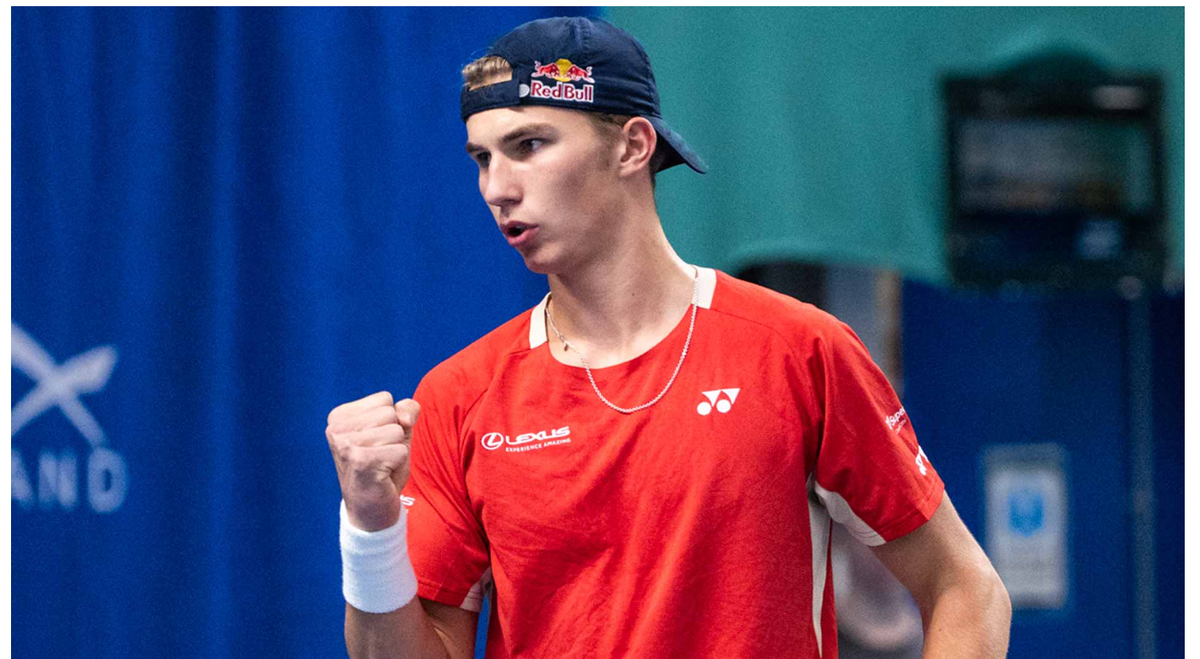
Nikolai Budkov Kjaer more or less came to prominence to some tennis fans for his Wimbledon junior grand slam title just over two years ago, but his transition to the main tour has not been quite so easy. The Norwegian is still kind of stuck at Challenger level and every time he seems to make some sort of progress he takes two steps back. Today he managed to prevail in a tight clash versus Switzerland's Paul in Roanne and I will break down the keys in which he was able to come out on top, but also the in-game issues the Norwegian still very much has as his time on court increases.
One of Budkov Kjaer's biggest strengths is the things he can do with his two-handed backhand and we saw that in the first break of serve he sealed to go *2-0.
As seen in this clip, Budkov Kjaer is extremely confident on pretty much any neutral ball when it comes to that groundstroke and even though he strikes a formidable backhand cross-court that draws the error here, the Norwegian has a great ability to redirect up the line with just as much ease. The backhand very rarely breaks down easily under pressure and it is a big part of what makes him the player he is. The forehand is a little more complicated as I will discuss later.
via ATP Challenger TV
The Swiss player was always eager in this encounter to sorta prevent this from being too much of a ball-striking contest which was probably advisable going into this as he hits a weaker ball, doesn't necessarily have a standout weapon and he was obviously aware of the threat the Norwegian possessed off the ground, too.
As seen here, Paul pretty much leaned on variety of ball more so than hitting big and the drop shot and lob collective was something he turned to quite a lot. It was effective in the sense that it continuously put Budkov on his heels, made some exchanges a little harder to predict and it was his way of preventing the set-up. Unfortunately that just wasn't enough in the end to beat the qualities that Budkov brought to the table on the day.
via ATP Challenger TV
When breaking down the Budkov forehand groundstroke it can quite easily be a weakness and a strength for him at the same time. In the first video this encapsulates why his ceiling has been limited to just 118 in the world, which he achieved in July this year. For a guy of his capabilities, for me, it solely comes down to this shot and this shot alone.
Budkov's forehand has an extreme back swing which means that there is significantly less margin for error in terms of beginning of the swing and the moment ball makes contact with racket, mainly because of the diminished timing window a player has. Budkov Kjaer falls in this category and it is basically why his forehand is one of the more time-dependent on the Challenger Tour at present. Bigger ball-strikers, fast hard courts and low-bouncing grass courts can be the Norwegian's worst nightmare when someone can exploit those deficiencies. Paul just did not do this enough and perhaps didn't have the explosivity to execute that kinda game either. The clip below illustrates the reason why Budkov is where he is in his career with time being taken away from his right wing far too often.
via ATP Challenger TV
With that being said, this is how Budkov's forehand can be a strength but it depends on how the point develops. It revolves around sometimes the backhand down the line doing the damage, getting his opponent in a position of peril and then when the forehand is there to be destroyed middle of the court he is very damaging in these scenarios. The issue is being able to get into those scenarios more often to elevate his ranking. This was essentially how he turned the match in his favour, more moments like this below and the 1st serve being both potent and reliable, which was key with the aggressive return position Paul was taking up time after time.
via ATP Challenger TV
The biggest moment in that 2nd set really came when Paul had a break point in hand at 5-5 in the 2nd set, and the Norwegian saves it off one big serve before breaking for the win in the following game.
The positives for Budkov was the way the serve looked, the fact that whenever his forehand did fall apart he did reset quite well throughout. But the question is whether he can carry it out on the quicker surfaces against players with similar groundstroke artillery to him or better.


Comments ()